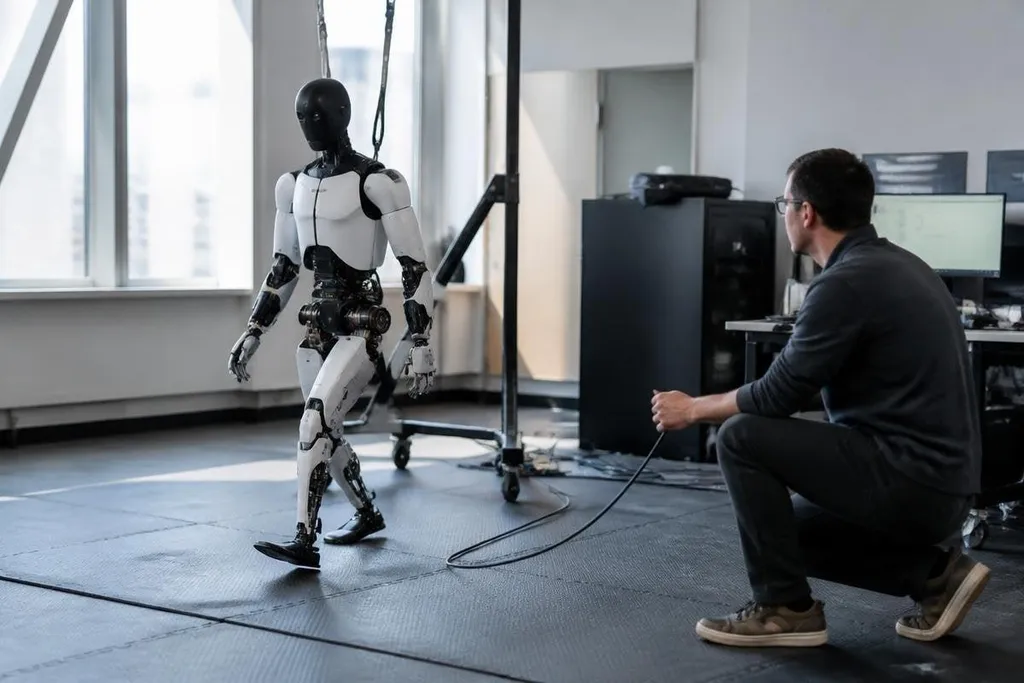
A humanoid robot learns to walk by repeating a cycle: sense its body, place its feet, shift its weight, and correct the next step. Engineers usually teach this skill in simulation first, then move it onto hardware where loose cables, floor grip, and motor limits change the problem.
Quick read
- Cameras, joint sensors, and force sensors tell the robot where its body and feet are.
- Simulation lets the control system repeat failed steps without damaging hardware.
- Walking on a real floor still exposes problems that a simulator may miss.
The robot starts with a body model
The control system needs a working model of the robot. That model includes the length of each leg, the mass of each part, the limits of each joint, and how quickly each motor can move.
Joint sensors report the angle of the hip, knee, and ankle. An inertial measurement unit tracks body motion, including tilt and rotation. A foot force sensor can show whether the sole is pressing into the floor or losing contact.
These readings arrive many times during each step. The robot compares them with the motion it expected, then changes motor commands when the body leans too far or a foot meets the floor earlier than planned.
Walking depends on the robot's center of mass. This is the point where its weight can be treated as acting. When that point moves outside the support area under the feet, the robot needs a fast step or a change in posture to avoid falling.
Simulation teaches the first steps
A simulator gives the robot a virtual body and floor. Engineers can set a walking goal, then let a control system try thousands of small actions. Each action may change joint speed, foot position, or body angle.
Reinforcement learning is one common method. The system receives a score for walking ahead, staying upright, using less energy, and placing its feet near the planned path. A fall lowers the score, so later attempts favor actions that kept the body stable.
The robot doesn't memorize one fixed sequence forever. It learns a control policy, which is a rule for choosing an action from the sensor readings. That lets it respond when the floor, speed, or body position changes.
Simulation saves hardware from endless falls, but it has a known limit. The virtual floor may have the wrong grip, the motor may react too quickly, or the model may miss flex in a foot joint.
Engineers add noise and random changes to the simulator to make the learned policy handle more cases.
Hardware changes the lesson
The first move from software to a real robot often uses slow speeds and a safety frame. The frame can catch the robot while engineers check whether the motors, sensors, and control loop behave as expected.
This loop repeats several jobs at once. It estimates body position, plans the next foot placement, sends commands to the joints, and checks the result. A delay in any part can turn a small lean into a fall.
Foot placement also matters after contact. The robot must lower its body weight onto the new foot, lift the old foot, and move the center of mass over the support area. That sequence takes less time than a person may notice, yet each stage changes the load on the joints.
A missed weight shift can turn one clean step into a stumble, even when the foot lands in the right place. For an engineer comparing humanoid systems, Robot24.com robotics coverage can put that walking method beside a named machine and test setting before the next section looks at why balance still breaks.
Why walking still fails
A robot can walk well on a flat test floor and struggle on a ramp, loose ground, or a surface with a small height change. Shoe material, battery weight, motor temperature, and worn gear parts can change the result.
A camera can also misread the floor when light changes or an object blocks the view. Force sensors help, but sensor data can arrive late or contain noise. The control system must react without making a large correction that creates a second problem.
Walking speed adds another limit. Faster steps leave less time to detect a mistake and move the next foot. A system trained only at low speed may need a separate policy for faster movement.
The hard part is making the robot recover. A planned step shows that the system works under expected conditions. A recovery step shows whether it can handle a push, a slip, or a foot that lands short.
A practical way to judge a walking demo
Use these checks when a company shows a humanoid walking:
- Check the floor: note the surface, slope, loose material, and visible support equipment.
- Watch the feet: look for foot placement, weight transfer, and recovery after contact.
- Look for cuts: a continuous clip gives more information than several short scenes.
- Ask about control: find out whether the motion is remote-controlled, scripted, or learned.
- Check the task: separate steady walking from carrying weight, turning, or crossing uneven ground.
I'd judge a walking system by recovery and repeatability before speed. A machine that takes careful steps for several minutes tells you more than one fast run followed by a cut.
The next useful proof is simple: the same robot walking across several floor types, carrying a stated load, with the full run shown from start to finish.